Why Is My Fuel Transfer Pump Slower Than Its Rated GPM?
Sep 21,2026 | Brearo
A fuel transfer pump rated for 15 or 20 GPM does not necessarily deliver that exact flow rate at the nozzle in every installation.
The pump may be working normally while the complete fuel transfer system is reducing the final flow.
Hose length, hose diameter, filters, meters, fittings, nozzles, suction lift, battery voltage, fuel temperature, and even tank venting can all affect how many gallons per minute you actually get.
So if your 20 GPM fuel transfer pump is only delivering 15 GPM, don't assume the pump is defective.
Start by asking a better question:
Where is the system losing flow?
This guide explains the difference between rated and actual GPM, how to measure your real flow rate, and the most common reasons a fuel transfer pump runs slower than expected.
Safety First: Fuel transfer equipment handles flammable or combustible liquids. Turn the pump off before inspecting hoses, filters, fittings, wiring, or other components. Keep sparks, flames, cigarettes, hot surfaces, and other ignition sources away from the work area. Follow the safety, fuel compatibility, wiring, installation, and maintenance instructions for your specific pump, tank, hose, nozzle, and accessories.
Quick Answer: Why Is My Fuel Transfer Pump Running Slower Than Its Rated GPM?
If a fuel transfer pump is delivering less than its rated flow, check these areas first:
| Possible Cause | What It Can Do | Check First |
|---|---|---|
| Dirty filter or strainer | Restricts fuel entering or leaving the pump | Filter and inlet screen |
| Long or undersized hose | Creates additional flow resistance | Hose length and diameter |
| Restrictive nozzle | Limits discharge flow | Nozzle size and compatibility |
| Meter or fittings | Adds pressure loss | Adapters, elbows and meter |
| Excessive suction lift | Makes it harder for the pump to draw fuel | Pump position and suction line |
| Low voltage | Reduces motor performance | Battery and wiring under load |
| Cold fuel | Increases resistance to flow | Fuel temperature and condition |
| Air leak or pump wear | Reduces effective pumping capacity | Suction connections and pump condition |
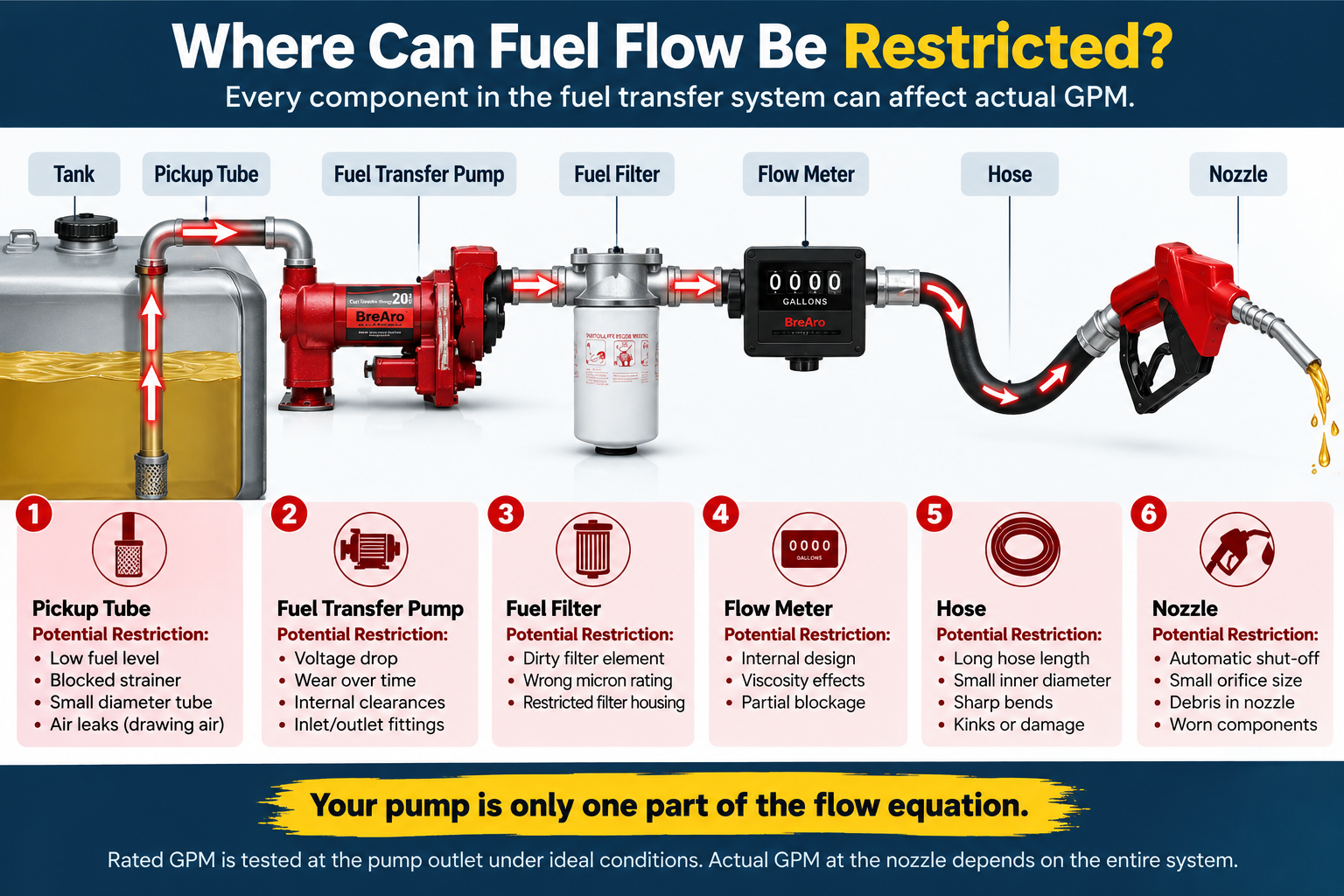
A fuel transfer pump is only one part of the system.
Think of the complete flow path:
Tank → Pickup Tube → Pump → Filter → Meter → Hose → Nozzle
Every component in that path can affect the final GPM at the nozzle.
Rated GPM vs. Actual GPM: What's the Difference?
GPM stands for gallons per minute.
A pump rated at 20 GPM is designed to move fuel at a specified flow rate under defined operating or test conditions. Those conditions do not necessarily match every real-world installation.
Once the pump is installed on a transfer tank, additional components begin affecting flow.
For example, your setup may include:
- A long suction tube
- A fuel filter
- A flow meter
- Several elbows or adapters
- A 15- or 20-foot delivery hose
- An automatic nozzle
- A truck battery supplying power
Each component can introduce some resistance.
That means there can be an important difference between:
Pump rated flow
and
Actual flow at the nozzle
This does not automatically mean something is wrong with the pump.
The important question is whether the flow you are seeing is reasonable for your system—or whether an unusual restriction, electrical problem, air leak, or worn component is reducing performance.
First: Measure Your Actual Fuel Flow
Before troubleshooting slow flow, find out how slow the system actually is.
Don't rely only on how fast the fuel “looks” like it is moving.
You can estimate your actual GPM with a simple calculation:
Actual GPM = Gallons Transferred ÷ Transfer Time in Minutes
For example:
If your system transfers 30 gallons in 2 minutes:
30 ÷ 2 = 15 GPM
If you are using a pump rated at 20 GPM, your measured nozzle flow is approximately 15 GPM under that particular setup and operating condition.
For a useful comparison:
- Use the same fuel.
- Use the same hose and nozzle.
- Test under similar tank and temperature conditions.
- Measure a meaningful volume rather than only a few gallons.
- Use a reliable method for determining the amount transferred.
Record the result.
That gives you a baseline you can compare after checking the system.
8 Reasons Your Fuel Transfer Pump May Be Below Its Rated GPM
1. Your Fuel Filter or Strainer Is Restricting Flow
Start with one of the simplest places: the filter.
A fuel filter protects equipment from contaminants, but it also creates resistance in the system.
As a filter collects:
- Dirt
- Rust
- Sediment
- Tank debris
- Water or other contamination
that restriction can increase.
A pump that once delivered acceptable flow may gradually become slower as the filter loads up.
The same applies to an inlet strainer or screen.
Signs of a possible filter restriction
You may notice:
- Flow has gradually decreased over time.
- The pump sounds normal but fueling takes longer.
- Performance improves after servicing the filter.
- The problem appeared after pumping from a dirty or older tank.
Inspect and replace filters according to the recommendations for your specific system.
Do not permanently remove a required filter simply to increase flow. Protecting downstream equipment from contaminated fuel is often more important than gaining a small amount of pumping speed.
2. Your Hose Is Too Long, Too Small, or Restricted
Your delivery hose can have a major effect on real-world flow.
In general, fuel moving through a longer hose encounters more resistance than fuel moving through a shorter hose of the same diameter.
Hose diameter matters too.
Trying to move a high volume of fuel through a smaller flow path can increase pressure loss and reduce the amount of fuel reaching the nozzle.
Inspect the hose for:
- Kinks
- Crushing
- Sharp bends
- Internal damage
- Improper diameter
- Excessive length
- Damaged swivels or connections
This becomes especially important when moving from a lower-flow pump to a higher-flow pump.
Installing a 20 GPM pump does not guarantee 20 GPM at the nozzle if the rest of the system was designed around a more restrictive flow path.
A common mistake
A user upgrades the pump but keeps:
- The same narrow hose
- The same filter
- The same fittings
- The same nozzle
The new pump has more potential flow, but the downstream system may prevent it from taking full advantage of that capacity.
Higher pump GPM works best when the rest of the system is sized to support it.
3. Your Fuel Nozzle Is Limiting Flow
The nozzle is the last component before the fuel reaches the receiving tank—and it can also be a restriction.
Different nozzles are designed for different applications and flow ranges.
An automatic shut-off nozzle, for example, contains additional internal components that allow it to stop flow when the receiving tank reaches the appropriate level.
That convenience can also make nozzle selection important when building a higher-flow fuel transfer system.
Check that your nozzle:
- Is compatible with the fuel being transferred.
- Is appropriate for the expected flow rate.
- Is not damaged or contaminated.
- Opens fully during dispensing.
- Has no obstruction in the flow path.
If the pump appears to run normally but flow at the nozzle is consistently low, the nozzle should be part of your inspection.
This becomes particularly important with 15 GPM and 20 GPM systems.
A high-flow pump should be matched with components capable of handling the intended flow.
4. Your Meter, Elbows, Adapters, or Fittings Add Resistance
One fitting may not seem important.
But a fuel transfer system may contain several:
- 90-degree elbows
- Reducers
- Quick-connect fittings
- Adapters
- Swivels
- Flow meters
- Check valves
- Filter heads
Every time the fuel changes direction or passes through a smaller internal passage, additional pressure loss may be introduced.
The problem often isn't one component.
It is the combination.
For example:
Pump → Filter → Reducer → Meter → Elbow → Long Hose → Automatic Nozzle
may behave differently from:
Pump → Properly Sized Hose → Nozzle
even when both systems use the same pump.
That does not mean you should remove components that are necessary for your application.
Instead, make sure each component is correctly sized and suitable for your expected flow.
One small restriction may not matter much. Several restrictions in the same system can add up.
5. The Pump Is Working Against Too Much Suction Lift
Fuel transfer pumps generally perform best when the suction side is kept as simple as practical.
Before fuel reaches the pump, it may need to travel through:
- A pickup tube
- Tank adapter
- Suction hose
- Fittings
- Vertical distance
The greater the suction challenge, the harder the pump has to work to pull fuel into the inlet.
Excessive suction lift, unnecessary bends, restrictive inlet fittings, or a long suction path can reduce system performance.
Also check for suction-side air leaks
An important point:
A suction fitting does not have to leak fuel outward to allow air inward.
A loose fitting, damaged seal, cracked suction hose, or poorly sealed connection may allow air into the system.
That can reduce pump efficiency and cause:
- Lower flow
- Intermittent flow
- Difficulty priming
- Loss of prime
- Bubbles in the system
Inspect the complete suction path:
Tank → Pickup Tube → Adapter → Suction Line → Pump Inlet
Keep the suction side airtight and follow the installation limits specified for your pump.
Don't forget the tank vent
As fuel leaves the source tank, air must be able to replace it.
If the tank cannot vent correctly, vacuum can develop inside the tank and reduce fuel flow.
If flow starts strong and then gradually becomes weaker, tank venting should be one of the things you check.
6. Your 12V Pump Is Not Getting Enough Voltage
A 12V fuel transfer pump needs more than a battery that simply reads “12 volts.”
What matters is the electrical supply while the pump is operating.
The motor may still run even when poor wiring or voltage drop is reducing its performance.
Possible causes include:
- Weak battery
- Loose battery clips
- Corroded terminals
- Undersized wire
- Excessive cable length
- Damaged cable
- Poor ground connection
- Loose electrical connections
A resting voltage measurement does not always tell the full story.
When appropriate for your system, check the electrical supply while the pump is operating and compare it with the requirements in your pump manual.
Also verify:
- Correct wire gauge
- Correct fuse
- Correct polarity
- Secure connections
- Proper grounding
- Recommended cable length
Never install a larger fuse simply because the existing fuse keeps blowing.
A repeatedly blown fuse indicates a problem that should be identified and corrected.
7. Cold Fuel Can Reduce Real-World Flow
Temperature matters.
Diesel fuel becomes more resistant to flow as temperature decreases.
That means the same fuel transfer system may not perform exactly the same way on a hot summer afternoon and a freezing winter morning.
Cold-weather operation can make existing restrictions more noticeable.
For example, a system with:
- A partially restricted filter
- A long hose
- Several fittings
- High suction lift
may seem acceptable in warmer weather but become noticeably slower when the fuel is colder.
If your fuel transfer pump only seems slow during winter, don't immediately blame the motor.
Consider:
- Fuel temperature
- Fuel condition
- Filter condition
- Suction setup
- Hose and fittings
Always use fuel and equipment appropriate for the operating temperature and follow the recommendations for your specific pump and fuel system.
8. The Pump or Another Component May Be Worn or Partially Blocked
If the external system checks out, the pump itself may eventually need attention.
Possible problems can include:
- Worn pump components
- Debris inside the pump
- Sticking internal components
- Damaged seals
- Internal restriction
- Wear from extended service
The most useful clue is often a change from previous performance.
Suppose your system has used the same:
- Tank
- Hose
- Filter type
- Nozzle
- Battery
- Fuel
for months.
If it previously transferred fuel at a consistent rate but suddenly becomes significantly slower, that change deserves investigation.
However, check the simple external causes first.
A clogged filter, weak electrical connection, suction leak, or blocked tank vent is generally easier to correct than an internal pump problem.
Avoid opening components that the manufacturer does not identify as user-serviceable.
For a broader troubleshooting sequence, see our Fuel Transfer Pump Troubleshooting Guide.
How Much Flow Loss Is Normal?
This is one of the most common questions:
“My pump is rated at 20 GPM, but I'm only getting 16 GPM. Is something wrong?”
There is no single percentage of flow loss that is “normal” for every installation.
Why?
Because two users can install the exact same pump in very different systems.
System A
- Short suction path
- Short, properly sized hose
- Clean filter
- Minimal fittings
- Strong electrical supply
System B
- Greater suction lift
- Longer hose
- Multiple elbows
- Flow meter
- Automatic nozzle
- Partially loaded filter
- Longer electrical cable
It would not be surprising for the two systems to produce different flow rates at the nozzle.
That is why the most useful comparison is often not:
Rated GPM vs. one random measurement
but:
Your system's normal baseline vs. its current performance
If the system has always delivered roughly the same flow, the installation may simply have more resistance than the conditions used to establish the pump's rated output.
If the same system suddenly becomes much slower, something has probably changed.
20 GPM Pump Only Delivering 15 GPM? Try This Troubleshooting Sequence
Imagine this setup:
- 20 GPM 12V fuel transfer pump
- Truck-mounted transfer tank
- Fuel filter
- Flow meter
- 20-foot hose
- Automatic nozzle
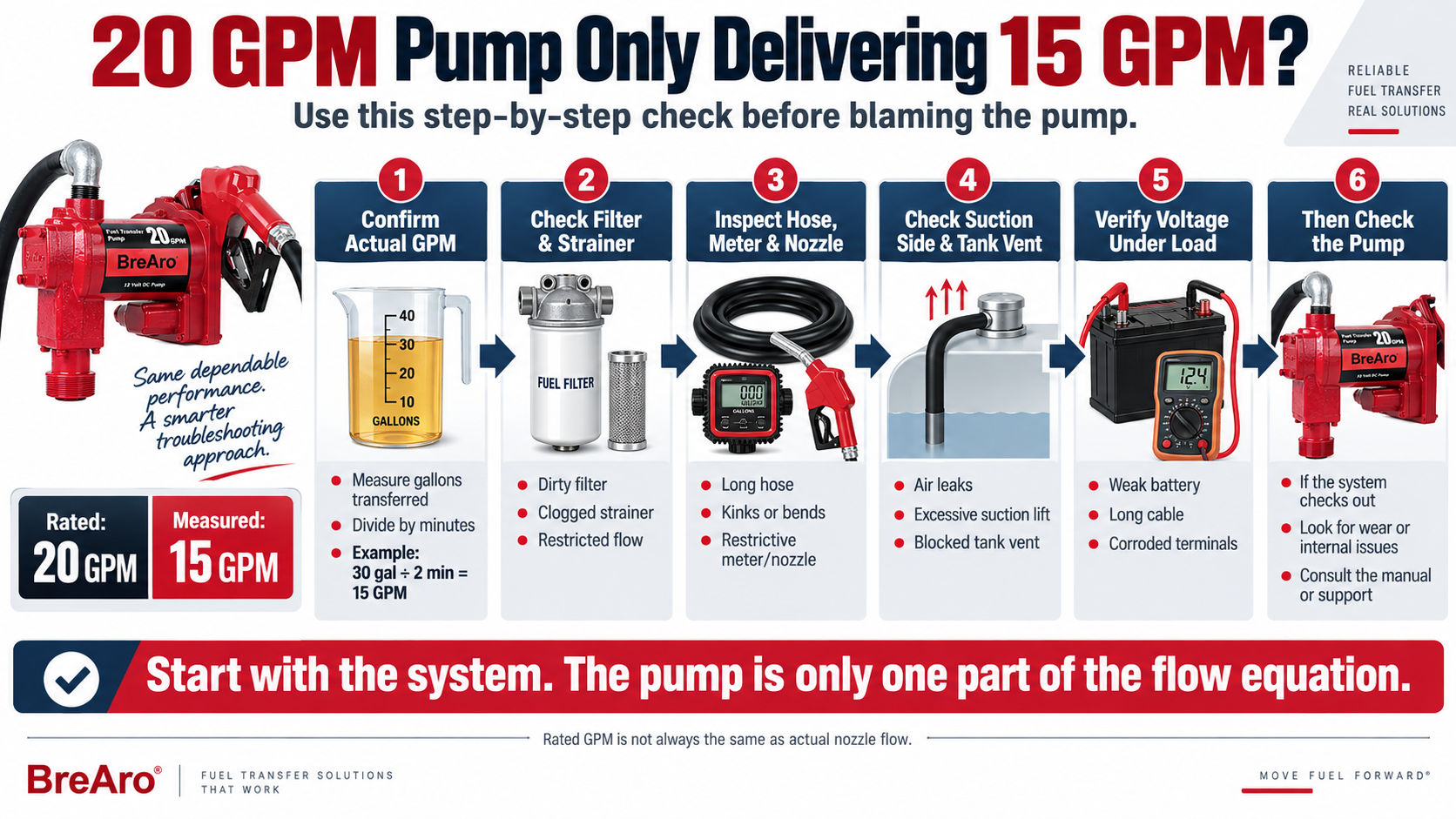
You measure the system and find that it transfers:
30 gallons in 2 minutes = 15 GPM
Don't immediately replace the pump.
Work through the system in a logical order.
Step 1: Confirm the Measurement
Repeat the flow test under similar conditions.
Make sure the measurement method is reliable.
If the result is consistently close to 15 GPM, continue.
Step 2: Inspect the Filter and Strainer
Check for dirt, contamination, or a filter that is due for service.
A partially restricted filter can reduce flow without stopping the pump completely.
Step 3: Inspect the Hose
Look for:
- Kinks
- Sharp bends
- Damage
- Crushing
- Improper sizing
Also confirm that the hose configuration is appropriate for the pump and intended flow.
Step 4: Check the Nozzle and Meter
Make sure both are suitable for the expected flow range and are operating correctly.
Inspect for contamination or damage.
Step 5: Check the Suction Side
Inspect:
- Pickup tube
- Tank adapter
- Suction hose
- Inlet fittings
- Seals
- Tank vent
Look for both restrictions and places where air could enter the system.
Step 6: Check Electrical Supply Under Load
Inspect battery terminals, cables, connections, fuse and ground.
Follow the pump manufacturer's electrical specifications.
Step 7: Consider Operating Conditions
Ask whether anything changed:
- Is the fuel colder?
- Was a longer hose installed?
- Was a different filter added?
- Was a meter added?
- Has the pump moved to another tank?
- Is the battery weaker?
- Has flow gradually decreased?
Changes often provide the fastest clue.
A 5-Minute Low-Flow Checklist
If your fuel transfer pump is running slower than expected, start here:
1. Measure actual GPM
Don't troubleshoot based only on feel.
2. Check the fuel level
Make sure the suction tube remains properly submerged.
3. Inspect the filter and strainer
Look for contamination or restriction.
4. Inspect the hose
Check diameter, length, bends, kinks and damage.
5. Check the nozzle
Make sure it is clean, undamaged and appropriate for the intended flow.
6. Inspect the suction side
Look for air leaks, loose fittings and excessive lift.
7. Check the tank vent
Make sure air can enter the tank as fuel leaves.
8. Inspect the meter and fittings
Look for unnecessary restrictions, damaged parts or undersized adapters.
9. Check voltage and wiring
Pay attention to electrical performance while the pump is operating.
10. Consider temperature and fuel condition
Cold fuel can make an already restrictive system perform more slowly.
If all of these areas check out and the pump still performs significantly below its previous baseline, consult the pump manual or technical support.
When Is Low Flow Actually a Pump Problem?
Low flow becomes more suspicious as a pump problem when:
- The system previously performed much better.
- Nothing in the installation has changed.
- The filter and strainer are clean.
- The hose and nozzle are not restricted.
- The tank is venting correctly.
- The suction side is airtight.
- The electrical supply is correct.
- The correct fuel is being used.
- The pump still produces substantially less flow than before.
At that point, internal wear or a pump component issue becomes more likely.
The key is change.
A system that has always delivered 15 GPM through a particular configuration is different from one that delivered 18 GPM last month and now delivers 9 GPM.
The second situation tells you that something has changed.
How to Get Better Flow From a Fuel Transfer Pump
If your pump is working properly but you want to reduce unnecessary system losses, focus on the complete setup.
Keep the suction path simple
Install the pump according to the manufacturer's suction-lift limits and minimize unnecessary restrictions before the pump inlet.
Use properly sized hose
Match hose diameter and length to the pump, nozzle, fuel and intended flow rate.
Reduce unnecessary fittings
Avoid adding reducers, elbows or adapters that are not needed.
Maintain the filter
A clean fuel system is important for both flow and equipment protection.
Match the nozzle to the pump
Make sure the nozzle is compatible with the fuel and suitable for the expected flow range.
Check electrical installation
For 12V pumps, use the wire size, fuse, connections and power source specified by the manufacturer.
Inspect the system regularly
Flow that gradually becomes slower can be an early warning of:
- Filter restriction
- Tank contamination
- Hose damage
- Loose connections
- Electrical corrosion
- Component wear
Catching the problem early can help prevent a complete loss of flow later.
Your Pump Is Only One Part of the Flow Equation
When a fuel transfer pump delivers less than its rated GPM, the pump itself is not always the problem.
Real-world flow depends on the entire fuel path:
Tank → Suction System → Pump → Filter → Meter → Hose → Nozzle
A restriction at any point can affect what you see at the nozzle.
Start by measuring your actual GPM.
Then work through the system in order:
Filter → Hose → Nozzle → Fittings → Suction → Vent → Voltage → Pump
This approach helps you identify the actual restriction instead of replacing parts unnecessarily.
And if you're choosing a new fuel transfer pump, remember that higher GPM is only useful when the rest of the system can support that flow.
Brearo offers 12V fuel transfer pump configurations for different flow requirements and fueling setups. Compare pump flow, hose size, nozzle type, fuel compatibility, electrical requirements, and your complete installation before choosing a system.
Compare Brearo Fuel Transfer Pumps
Frequently Asked Questions
Why is my 20 GPM fuel pump only pumping 15 GPM?
A 20 GPM rating does not mean every installed system will deliver exactly 20 GPM at the nozzle. Hose length and diameter, filters, meters, fittings, nozzle restriction, suction lift, voltage, fuel temperature, tank venting, and other installation conditions can reduce actual flow.
Measure your current GPM and inspect the complete fuel path before assuming the pump is defective.
Does a fuel filter reduce GPM?
A filter introduces some resistance into a fuel transfer system, and that resistance can increase as the filter collects contamination.
A dirty or restricted filter can noticeably reduce fuel flow.
Use a filter that is correctly sized for the system and replace or service it according to the manufacturer's recommendations.
Does a longer fuel hose reduce flow?
It can.
Longer hose generally creates more resistance than a shorter hose of the same diameter. Hose diameter, bends, internal condition and the rest of the system also affect the final result.
If you need a long dispensing hose, make sure the complete system is designed for the intended flow.
Can an automatic fuel nozzle reduce flow?
A nozzle is part of the discharge system and can influence final flow.
Different nozzle designs have different internal passages and intended flow ranges. Make sure the nozzle is compatible with the pump, fuel and expected GPM.
If an automatic nozzle repeatedly shuts off early, see our Fuel Transfer Pump Troubleshooting Guide.
Can low battery voltage make a 12V fuel transfer pump slower?
Yes.
Poor connections, low battery voltage, excessive cable length, undersized wiring or corrosion can affect electrical performance.
The motor may still run even when the electrical supply is not adequate for normal pump performance.
Follow the electrical specifications for your exact pump and inspect the supply while the pump is operating.
Can cold weather reduce fuel transfer pump flow?
Yes.
Fuel properties change with temperature, and colder diesel can create more resistance to flow.
Cold conditions may also make an existing filter, suction or hose restriction more noticeable.
How do I calculate the actual GPM of my fuel transfer pump?
Measure how many gallons are transferred and divide that number by the transfer time in minutes.
For example:
40 gallons ÷ 2.5 minutes = 16 GPM
Repeat the test under similar conditions if you want to compare performance over time.
Is rated GPM the same as flow at the nozzle?
Not necessarily.
Rated pump flow is established under specified conditions. Your installed system adds components such as suction plumbing, filters, meters, hose, fittings and a nozzle.
Those components can affect the final flow rate you measure at the dispensing point.
Comment