Fuel Transfer Pump Runs but Won’t Pump? 7 Causes and Fixes
Aug 18,2026 | Brearo
You flip the switch. The motor starts. You can hear the fuel transfer pump running.
But nothing comes out of the nozzle.
Before assuming the pump has failed, check the rest of the fuel transfer system. When a motor runs but the pump won’t move fuel, the problem is often somewhere between the tank, suction line, pump inlet, filter, hose, and nozzle.
The fastest way to find the problem is to work through the system in order, starting with the simplest causes.
Below are seven common reasons a fuel transfer pump can run without pumping fuel—and what to check before you replace the pump.
Safety First: Fuel transfer equipment combines electricity, moving components, and flammable liquids. Turn the pump off before inspecting fittings, hoses, filters, or internal components. Clean up spills immediately, keep ignition sources away from the work area, and always follow the instructions for your specific pump and fuel tank.
Quick Diagnosis: Pump Runs but No Fuel Comes Out
| What You Notice | Possible Cause | Check First |
|---|---|---|
| Motor runs normally, but no fuel moves | Pump has lost prime | Fuel level and suction tube |
| Pump won’t pull fuel from the tank | Air entering suction side | Inlet fittings and seals |
| Flow slowed before stopping | Restriction or blockage | Strainer, inlet and filter |
| Pump starts strong, then flow fades | Tank not venting correctly | Tank vent |
| Pump struggles with a difficult installation | Excessive suction restriction | Hose length, lift and fittings |
| Pump delivers weak or intermittent flow | Restricted discharge side | Filter, hose and nozzle |
| Everything outside the pump checks out | Internal pump issue | Pump internals/service manual |
Tip: Start outside the pump. A loose fitting or clogged filter is much easier to fix than a pump you disassembled unnecessarily.
1. The Pump Has Lost Its Prime
A transfer pump needs to be able to draw fuel from the tank and establish continuous fuel flow through the inlet side.
If the suction line contains too much air, the pump may run normally without moving fuel.
This can happen after:
- The tank runs very low or empty
- The pump has been removed or reinstalled
- A suction-side fitting has been disconnected
- The system has been sitting unused
- Air has entered through a loose connection
Signs the pump may have lost prime
You may notice:
- The motor sounds normal
- No fuel reaches the nozzle
- The pump worked correctly before the tank ran low
- Fuel appears briefly and then disappears
- The pump starts working after the inlet side is properly primed
What to check
Start with the basics.
1. Check the fuel level.
It sounds obvious, but make sure there is enough fuel in the tank for the pickup or suction tube to remain submerged.
2. Inspect the suction tube.
Make sure it reaches the fuel and has not come loose, cracked, or shifted inside the tank.
3. Check the pump inlet.
Confirm that the suction line and fittings are properly installed and tight.
4. Follow the priming procedure for your pump model.
Different pump designs have different requirements. Always use the manufacturer’s instructions rather than assuming every transfer pump primes the same way.
Avoid extended dry running
If the pump is not moving fuel, don’t simply let the motor continue running while hoping it eventually starts pumping.
Some pump designs can be damaged by extended dry operation.
If the pump does not establish flow within the expected priming procedure, shut it down and continue troubleshooting.
2. There’s an Air Leak on the Suction Side
This is one of the most important things to understand when troubleshooting a fuel transfer pump:
A fitting does not have to leak fuel outward to leak air inward.
The suction side of the system operates differently from the discharge side. When the pump is trying to pull fuel from the tank, a small opening at a fitting, seal, adapter, or hose connection can allow air into the system.
Once enough air enters, the pump may struggle to create the suction needed to move fuel.
Common places for suction leaks
Inspect:
- Suction pipe connections
- Threaded fittings
- Pump inlet fitting
- Tank adapters
- Hose connections
- O-rings
- Seals
- Damaged suction hose
- Poorly sealed threaded connections
Don’t rely only on visible fuel leaks
A common assumption is:
“There’s no diesel leaking around the fitting, so the connection must be good.”
Not necessarily.
A suction-side connection can sometimes pull air inward without producing an obvious fuel leak outward.
That is why each connection between the tank and pump inlet should be inspected carefully.
What to do
Turn the pump off and check the entire suction path:
Tank → Pickup Tube → Adapter → Suction Line → Pump Inlet
Look for:
- Loose fittings
- Damaged seals
- Cracked hoses
- Incorrectly assembled connections
- Missing or damaged O-rings
- Connections that may not be properly sealed
Correct the problem using components and sealing methods compatible with the fuel being transferred.
Then test the system again.
3. The Suction Tube, Strainer, or Pump Inlet Is Blocked
Fuel tanks are not always perfectly clean.
Over time, a transfer tank may collect:
- Dirt
- Rust
- Sediment
- Paint flakes
- Tank debris
- Contamination introduced during filling
If that material reaches the pickup tube, inlet screen, strainer, or pump inlet, it can restrict fuel before it ever reaches the pump.
Common signs of an inlet restriction
A blockage may be more likely if:
- Fuel flow became slower over time
- The pump works intermittently
- The pump originally worked well but gradually lost performance
- The problem appeared after using an older or dirty tank
- The motor sounds normal but very little fuel moves
Check the system in order
Instead of immediately opening the pump, trace the fuel path.
Start at the tank:
Tank → Pickup Tube → Strainer → Suction Line → Pump Inlet
Inspect each point for contamination or obstruction.
If your system includes an inlet strainer, check whether debris has accumulated there.
Also inspect flexible suction hose for damage. A hose that is kinked, internally damaged, or otherwise restricted can reduce the amount of fuel reaching the pump.
Field Tip
If the pump was working normally and then began delivering progressively less fuel before stopping, a restriction should be high on your troubleshooting list.
Fix the restriction before assuming the motor or pump assembly has failed.
4. The Fuel Filter Is Clogged
A fuel filter protects downstream equipment by catching contamination.
But as the filter collects debris, it also creates resistance to flow.
Eventually, a severely restricted filter can make a healthy fuel transfer pump appear weak—or prevent normal fuel delivery altogether.
Signs of a restricted filter
Look for:
- Flow that has gradually slowed
- Longer refueling times
- Normal motor sound but poor output
- A filter that has not been serviced for a long time
- Heavy contamination visible in the filter or housing
- Flow problems that began after transferring contaminated fuel
What to check
Inspect:
- The filter element
- Filter housing
- Correct flow direction
- Fittings going into and out of the filter
- Condition of any water-blocking element if your system uses one
If the filter is clogged or damaged, replace it with the correct type for your fuel transfer system.
Don’t permanently remove filtration just to gain flow
Removing a filter may appear to solve a flow problem, but operating without appropriate filtration can allow contamination to move farther into the pump, meter, nozzle, vehicle, or equipment being fueled.
The better solution is to identify why the filter is restricted and replace it when necessary.
5. The Fuel Tank Isn’t Venting Properly
When fuel leaves a transfer tank, something has to replace that volume.
Usually, that something is air.
The tank vent allows air to enter as fuel is pumped out. If the vent becomes blocked, the pump can begin working against increasing vacuum inside the tank.
The result may be reduced fuel flow—or eventually no flow at all.
Typical signs of a venting problem
A tank vent deserves attention when:
- The pump starts with good flow
- Flow gradually becomes weaker
- Fuel delivery stops after the pump runs for a while
- The problem returns repeatedly during longer fueling sessions
- Other suction-side components appear normal
What to inspect
Depending on the tank design, check the:
- Tank vent
- Vent cap
- Breather
- Vent opening
- Area around the vent for dirt or debris
Do not modify the tank or operate it in a way that conflicts with the tank manufacturer’s instructions.
Fuel tanks and venting systems are designed for specific operating conditions, so use the correct replacement parts if service is required.
6. The Suction Setup Is Making the Pump Work Too Hard
Not every no-flow problem is caused by a failed part.
Sometimes the system itself is working against the pump.
Every fuel transfer pump has operating limits. Pump performance can be affected by how far the fuel has to travel before reaching the pump and how much restriction exists along that path.
Potential problems include:
- Excessive vertical distance between the fuel and pump
- An unnecessarily long suction line
- Suction hose that is too small for the system
- Too many elbows or fittings
- Kinked or damaged hose
- Restricted tank fittings
- Cold, more viscous fuel
- A combination of several small restrictions
Think about the suction side as a system
A simple installation might look like:
Tank → Short, Properly Sized Suction Line → Pump
A more difficult installation might look like:
Tank → Long Suction Hose → Multiple Elbows → Restrictive Fittings → Pump Mounted High Above Fuel Level
Even if every individual component works, the second installation creates more work for the pump.
Check your pump’s specifications
Do not assume that every 12V fuel transfer pump can handle the same suction lift or plumbing configuration.
Check the specifications for your exact model, including:
- Maximum recommended suction conditions
- Hose or pipe requirements
- Fuel compatibility
- Installation orientation
- Duty cycle
- Recommended fittings
Brearo offers several transfer pump configurations for mobile tanks, farms, fleets, construction equipment, and truck-mounted fueling systems, so the correct setup depends on the pump and application.
Keep the suction side simple
As a general installation principle, aim for a suction path that is:
Short. Sealed. Unrestricted. Correctly sized.
That helps the pump do its job with fewer variables.
7. Internal Pump Components May Be Worn or Damaged
If the tank has fuel, the suction side is airtight, the inlet is clear, the filter is good, the tank is venting correctly, and the installation is within specification, then the problem may be inside the pump.
Depending on the pump design, internal problems can involve components such as:
- Vanes
- Gears
- Rotor components
- Seals
- Bypass components
- Internal valves
- Other moving pump parts
Internal damage may be more likely if:
- The pump has seen heavy use
- The pump has repeatedly run dry
- Contaminated fuel has passed through it
- The motor or pump makes unusual noises
- Fuel flow became progressively worse before stopping
- The pump recently overheated
- All external causes have been eliminated
At this stage, random disassembly usually isn’t the best first move.
Turn the pump off and consult the service information for your exact model.
If service procedures are outside your experience level—or if the pump has electrical damage, fuel leakage, or significant mechanical damage—stop using the equipment until it can be properly inspected.
A 5-Minute Troubleshooting Sequence
If the motor runs but no fuel comes out, use this order:
1. Confirm there is fuel in the tank
Make sure the pickup tube remains submerged.
2. Check the suction tube
Look for loose connections, damage, or incorrect positioning.
3. Verify the pump is properly primed
Follow the procedure for your exact model.
4. Inspect every suction-side connection
Look for places where air could enter the system.
5. Check for restrictions
Inspect the pickup tube, inlet, strainer, filter, hose, and nozzle.
6. Check the tank vent
Make sure the tank can admit air as fuel leaves.
7. Review the installation
Look at suction lift, hose length, hose size, elbows, fittings, and other restrictions.
8. Inspect the pump itself
Only after the external system has been checked should internal pump problems move to the top of the list.
The rule is simple: start with the easiest external causes before opening the pump.
What If the Pump Works but Fuel Flow Is Very Slow?
A pump that still moves fuel—but much slower than expected—can share many of the same problems.
Check for:
- A dirty fuel filter
- Blocked inlet strainer
- Restricted suction hose
- Excessive hose length
- Improper hose diameter
- Excessive suction lift
- Air entering the suction side
- Restriction at the nozzle
- Low voltage on a 12V system
- Cold or more viscous fuel
- Worn internal pump components
Also remember that the advertised maximum flow rate of a pump does not necessarily mean every installed system will deliver that exact rate at the nozzle.
Tank configuration, hose length, filters, meters, fittings, nozzle restriction, fuel condition, voltage, and suction conditions can all affect real-world flow.
If your pump still moves fuel but refueling takes much longer than it used to, troubleshoot the entire fuel path rather than looking only at the motor.
What If the Pump Keeps Losing Prime?
A transfer pump that works after priming but repeatedly loses prime is giving you another clue.
Focus your inspection on the suction side.
Check:
- Loose inlet fittings
- Suction-side air leaks
- Damaged seals or O-rings
- Cracked suction hose
- Pickup tube position
- Low tank fuel level
- Any model-specific check valve or inlet components
Repeated loss of prime usually means you should find out how air is getting into the system or why fuel is not remaining where the pump needs it.
Simply priming it again every time treats the symptom, not the underlying problem.
When Should You Stop Troubleshooting?
Some problems should not be handled by repeatedly switching the pump back on.
Stop operating the fuel transfer system if you notice:
- Active fuel leakage
- Damaged electrical wiring
- Frayed power cables
- Sparks
- Burning smell
- Smoke
- Severe overheating
- Cracked pump housing
- Abnormal grinding or mechanical noise
- Repeated fuse failure
- Damaged hose or fittings that could leak fuel
Turn the equipment off and disconnect power according to the manufacturer’s instructions before service.
Never continue operating fuel transfer equipment when an electrical or fuel-leak hazard is present.
Getting a machine back to work quickly matters.
Getting it back to work safely matters more.
How to Prevent No-Flow Problems
Troubleshooting is useful.
Preventing the problem is better.
A few routine checks can help reduce unexpected downtime.
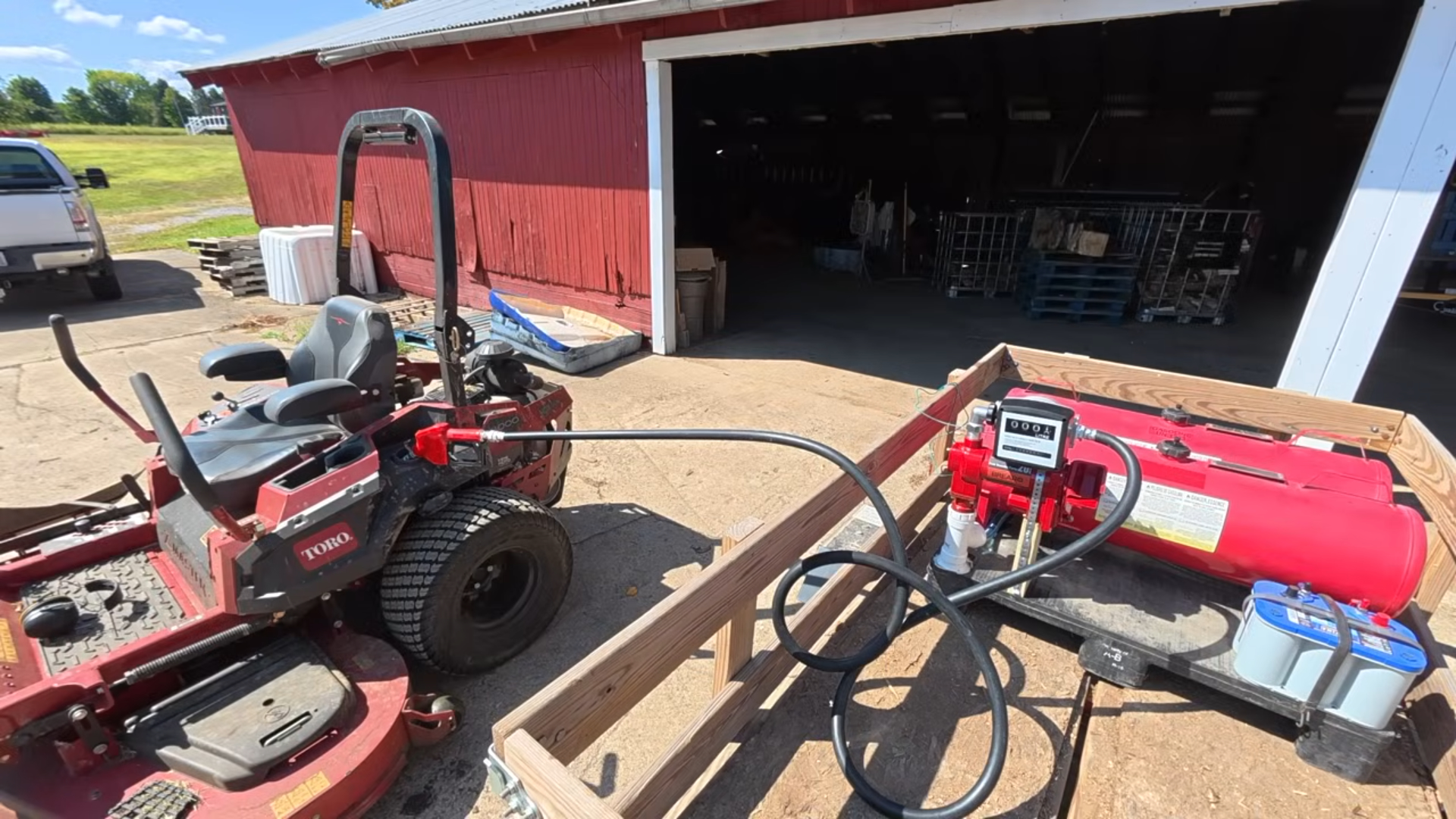
Keep the tank clean
Contamination at the bottom of a transfer tank can eventually reach the pickup tube, strainer, filter, or pump.
Inspect tanks periodically and avoid introducing dirt or debris during filling.
Service fuel filters
Filters are wear items.
Inspect and replace them according to the equipment manufacturer’s recommendations and the conditions in which the system operates.
A farm or construction environment with significant dust and contamination may require more frequent attention than a cleaner application.
Inspect fittings and hoses
Truck-mounted and mobile fuel systems are exposed to vibration, weather, dirt, movement, and repeated use.
Periodically inspect:
- Suction fittings
- Hose connections
- Seals
- Hoses
- Tank adapters
- Pump mounting
A connection that was tight when installed may deserve another look after months of field use.
Avoid repeatedly running the tank dry
Allowing the pickup to draw air can cause the system to lose prime.
Keeping an eye on tank level makes troubleshooting one less problem during a busy workday.
Pay attention when flow changes
A pump usually doesn’t need to reach zero flow before it deserves attention.
If refueling suddenly takes noticeably longer, inspect the system.
Reduced flow can be an early sign of:
- Filter restriction
- Tank contamination
- Air leaks
- Hose problems
- Pump wear
Finding the problem early can help prevent downtime later.
Frequently Asked Questions
Why does my fuel transfer pump run but not pump fuel?
Common causes include loss of prime, an air leak on the suction side, a blocked pickup or inlet, a clogged filter, improper tank venting, excessive suction restriction, or an internal pump problem.
Start with the tank and suction side before assuming the pump itself has failed.
How do I know if my fuel transfer pump has lost prime?
If the motor runs normally but the pump does not draw fuel—and the pump begins working again after following the correct priming procedure—loss of prime may have been the cause.
If it keeps happening, inspect the suction side for leaks or other problems rather than repeatedly priming the system.
Can a clogged fuel filter stop a transfer pump from pumping?
A heavily restricted filter can significantly reduce fuel flow and, in severe cases, make it appear that the pump is no longer delivering fuel properly.
Inspect the filter whenever flow has gradually decreased.
Can an air leak prevent a diesel transfer pump from working?
Yes.
A leak on the suction side can allow air into the system and prevent the pump from drawing fuel effectively.
Remember that a suction-side air leak may not always produce an obvious external fuel leak.
Why does my fuel transfer pump work for a while and then stop?
If the pump initially delivers normal flow and then becomes progressively weaker, check tank venting and restrictions in the fuel path.
Also check the pump’s duty-cycle requirements and watch for overheating.
Why is my transfer pump running but pumping very slowly?
Possible causes include a clogged filter, inlet restriction, suction leak, excessive hose length, restrictive fittings, low electrical supply voltage, nozzle restriction, difficult suction conditions, or internal wear.
Can cold weather reduce fuel transfer flow?
Yes.
Fuel viscosity changes with temperature, and colder conditions can make a transfer system work harder and reduce flow.
If a problem appears only in cold weather, inspect both the fuel condition and the overall suction-side setup.
Pump Running, No Fuel? Start With the System
If your fuel transfer pump runs but won’t move fuel, don’t immediately assume the pump is bad.
Work through the system in this order:
Fuel Level → Prime → Suction Leaks → Blockage → Filter → Tank Vent → Installation → Pump Internals
That order matters.
It helps you eliminate simple problems first and avoids replacing equipment when the real issue may be a fitting, filter, pickup tube, or installation condition.
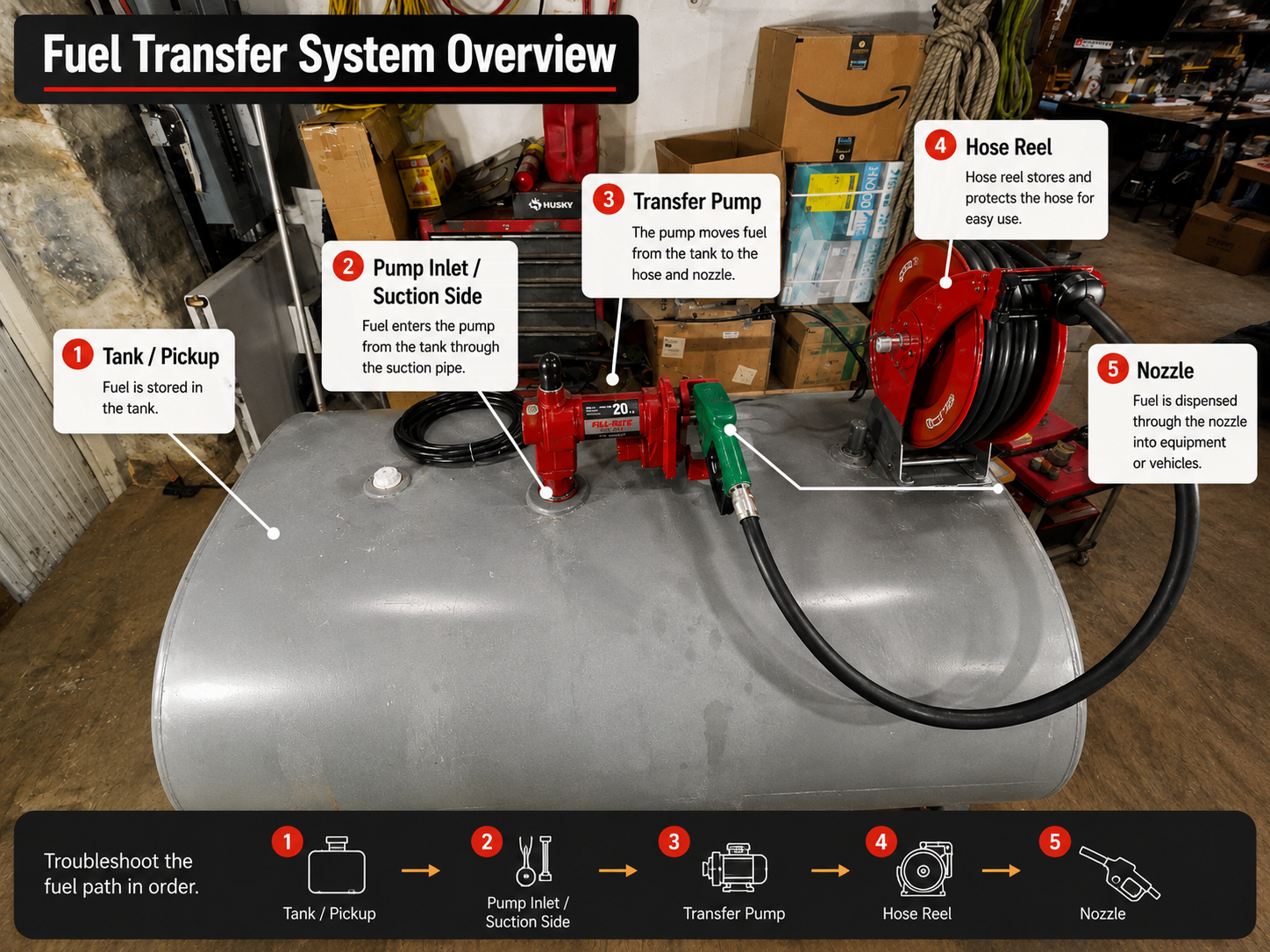
And remember: a fuel transfer pump is only one part of the fueling system.
The tank, suction line, fittings, filter, meter, hose, reel, and nozzle all have to work together.
A better setup means faster fueling, fewer interruptions, and less time standing next to a machine wondering why fuel isn’t moving.
Need a More Reliable Fuel Transfer Setup?
Brearo fuel transfer pumps are built for real-world fueling applications including truck-mounted tanks, farms, equipment fleets, construction equipment, and mobile fueling systems.
Explore Brearo’s range of 12V fuel transfer pumps, available in configurations designed for different flow requirements and fueling setups.
Less downtime. Faster fueling. Better setups.
Comment